"A girl was never ruined by books," my mother used to say. I've spent most of my life trying to prove that wrong.

Friday, May 31, 2013

Jane Jacobs, Bikes, and Brasilia

Bike shares hit New York last week, and Tbe New Yorker commemorated it with a cover that points up one of the follies of urban life.

Made me wonder what Jane Jacobs, that lover of New York and walkable/bikeable cities, would think.  The late urbanist, whose iconoclastic ideas turned thinking about cities on its head in the 1960s, was a friend of the bicycle: she spent hours one summer helping her son assemble bikes that he'd imported from China as part of an attempt to get people on two wheels.

As the success of bike-share programs show, her ideas are increasingly relevant. An appreciation of that comes out in the recent collection of essays on her and her legacy, called What We See: Advancing the Observations of Jane Jacobs. Edited by Stephen A. Goldsmith and Lynne Elizabeth, it contains more than 30 short reflections about what Jacobs meant in New York, Toronto and around the world, how her ideas have been influential, and how events elsewhere demonstrate her perspicacity. It ends with a series of questions about each essay that could serve as points of departure for discussion by community groups about their own particular problems, or as study guides in urban affairs programs.

Let me say straight up that Jane Jacobs is one of my heroes. Her ideas about cities inspired my book Green City: People, Nature and Urban Places, and she is a character in my  The Walkable City: From Haussmann’s Boulevards to Jane Jacobs’ Street and Beyond. When What We See... came out,  I spent several evenings dipping into it with pleasure. And by chance  at the same time I was also reading James Holston’s The Modernist City, an anthropological study of Brasília which in many respects is the antithesis of what Jacobs’ stood for.

The two books go together like hand in glove, although there is no mention of Jacobs in Holston’s work. The Brazilian capitol which celebrated its 50th anniversary in April, 2010, was conceived as an egalitarian model city inspired by the Swiss architect Le Corbusier exactly at the moment that Jacobs was noting the problems the modernist idea was presenting elsewhere. Brasília features big blocks of residences, grand vistas of public buildings, wide highways for automobiles and no streets.

From the beginning, however, the people who built it and the people who wanted to live there tried to undo the modernist vision. One example which Jacobs would have appreciated is the way storekeepers given space in large buildings where the entrances were to be on verdant parkland, switched their shops’ orientation. The opposite side, facing on the walkways and parking lots intended for provisioning the stores, became the “fronts” because people wanted the bustle of a street-like setting.

It’s interesting that one of the contributors to What We See is Jaime Lerner, the former mayor of another Brazilian city, Curitiba. Beginning in the 1970s, the main commercial streets there became pedestrian, and an integrated public transportation system has developed to become a model of how to woo people away from private car and to stop urban sprawl of both the middle class and the slum variety.

Perhaps because I live in a Canadian city and because I’ve followed Jacobs’ thought for more than 40 years, I found contributions from writers outside North America the most interesting and original parts of What We See. For example, Matias Echanove and Rahul Srivastava’s essay “The Village Inside” told me much I didn’t know about how Tokyo grew by incorporating villages into the urban fabric. The result was a rich—if sometimes “messy” looking—mix of residential, commercial and industrial uses. Dharavi, the Mumbai slum featured in Slumdog Millionaire, has several points in common with the Tokyo of the early 20th century, the authors suggest. I bet London of the 19th century did too. The lessons to draw from these examples underscore the importance of working on a human scale to integrate different elements in a growing city, and not to raze what’s there or try to build a city on a virgin site as was done in Brasília.

As for biking in Brasilia, it wouldn't seem that people do much of it.  Here's a video made last November of a group, Pedal Noturno, of night bike riders crossing a bridge in the city.  The fact that there are so few riders suggests that biking doesn't have the cachet it has elsewhere--or that it's anything but something to do on special occasions.
 

Wednesday, May 29, 2013

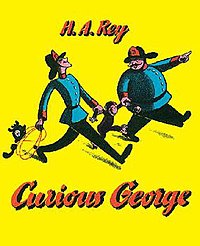
Why Curious George Starts in Paris and Ends in New York

Reading and the love of books can't encouraged too soon.  The Curious George books by H.A. and Margaret Rey were great favourites of our kids and Jeanne has delighted in them ever since Elin brought a jumbo book containing six tales back from a trip to New York last fall.  She went looking for our old copies shortly thereafter so ever since Jeanne's been read the old ones--now in  tatters--when she visits here.

The stories are still charming, but one of the things that goes over Jeanne's head is the way that the city George lives in changes between books.  In the first one it's quite clearly Paris, and the zoo where he goes to live is the Ménagerie in the Jardin des plantes, but the next one is just as clearly New York.

The reason why came clear this morning when the quality French language daily here Le Devoir had an article about an exhibit on George's creators.  The Reys were German Jews who met in Brazil where each had gone separately as young people.  Rey (born Hans Augusto  Reyersbach) and the former Margarete Elisabeth Waldstein founded the first advertising agency in Rio in the 1930s, but decided to go back to Europe, setting up shop in Paris.  The curious little monkey appears to have been just one of their projects.

In 1939 the French publisher Gallimard was ready to bring out the first book about the monkey, then called Fifi, but the Reys' studio was searched by the French police  on a tip that there might be material for making bombs there.  The sketches of George convinced the flics that wasn't the case, but the Reys took the hint  the following spring.  They decamped for Portugal, taking with them only their Brazilian passports, their sketches and what was left of their advance from Gallimard.  At the Spanish border their German accents raised eyebrows with Franco's Fascists, but the innocuous drawings of George and their Brazilian nationality allowed them to continue.  Their journeyed back to Brazil and then on to New York, where they started over again.

George once again came to their rescue.  Within a month they had a contract with Houghton Mifflin and the first Curious George book was published in 1941.  Since then 17 million copies of the various Curious George stories (the Reyes produced seven, and a  series has been spun off, written and drawn by others which are not nearly as good.)

The Reyes adventures are highlighted in a exhibit at the Montreal Holocaust Museum from now until June 22. The show was created by Omaha, Nebraska, Institue for Holocaust Education, and is touring North America.  Definitely worth the detour. 


Thursday, May 23, 2013

Water Works: Michael Ondaatje's Excellent In the Skin of a Lion

All the chit chat this morning around the water fountain (well, the gallon jug of bottled water put out by the bosses ) has been about how Montrealers are coping with a boil water order.  Seems routine maintenance at a treatment plant stirred up sediment yesterday, leading to the precautionary measure that went into effect Wednesday morning, and won't be lifted to this evening at the earliest.

 Water is such a commonplace substance that one tends to forget about it, except in times like these.  But providing safe tap water requires immense effort, and the stories connected with can take on elements of saga.

 Michael Ondaatje realized that 25 years ago when he researched and wrote  In the Skin of a Lion.  It was his second novel, following several volumes of poetry and literary criticism, so I remember being surprised when I read it at the way it portrayed immigrant life in the Toronto of the early 1900s.

 Apparently he spent days and days reading newspapers from the period, trying to get the facts right about the building of the city's water treatment plant and delivery system.  Among the many characters are Macedonians who came expressly to work on the project, most of whom ended up going back when the work was done.  Two of the characters, Hana and Caravaggio, turn up in his next, more famous novel, The English Patient.

 But the novel is far from a realistic, muck-raking exposé of the conditions of the people who worked on the project--and by extension on similar projects all over the continent.  Ondaatje is a poet, remember, and his imagery, descriptions  and portrayal of character raise the book to a very high level.  It's what John Steinbeck might have written if he'd been William Faulkne, a tough story that shimmers like reflections on water.

The original cover, by the way, shows what can happen when Socialist Realism is kicked upstairs to become High Art.